A closer look at what makes linen linen—fibre, yarn, weave, texture, weight, and finish.
Linen has a way of revealing itself slowly.
At first glance, it may appear simple: a natural fabric with a distinctive surface and an easy, relaxed character. Look closer, however, and there is an entire language beneath that surface—one shaped by the flax fibre, the construction of its yarn, the way it is woven, and the finishing that gives the cloth its final personality.
To understand fine linen, it helps to look beyond the finished garment.
Begin with the fibre.
The Fibre: Where Linen Begins
Every linen story starts with flax.
The long fibres within the flax stem are separated, prepared and aligned before they can become yarn. Their natural length, strength and fineness influence what can ultimately be achieved in the finished cloth.
This is why the origin of the fibre matters. European flax cultivation has a long-established relationship with textile production, with northern France, Belgium and the Netherlands among the principal flax-growing regions of Europe.
But fibre alone does not determine the character of linen.
The next transformation is where its personality begins to emerge.
The Yarn: Giving Fibre a Character
Loose flax fibres cannot become fabric on their own.
They must first be spun into yarn.
The way fibres are prepared and spun influences the yarn’s strength, regularity and appearance. A finer, more controlled yarn can create a smoother and more refined surface, while different yarn constructions can introduce greater visual texture and character.
In other words, the personality of linen begins before the loom ever starts moving.
The fibre provides the raw material.
The yarn gives it direction.
The weave gives it form.
The Weave: Where Structure Appears
Once the yarn is ready, it is woven into cloth.
The simplest way to understand weaving is as an intersection of two systems of yarn: the warp, running lengthwise, and the weft, running across it.
But within this fundamental structure lies enormous creative possibility.
Different constructions can influence:
- Surface texture
- Opacity
- Weight
- Drape
- Breathability
- Structure
- Visual depth
A closely constructed linen can feel clean and refined. A more visibly textured construction can feel relaxed and expressive.
The difference may be subtle to the eye—but unmistakable to the hand.
Texture: The Signature You Can Feel
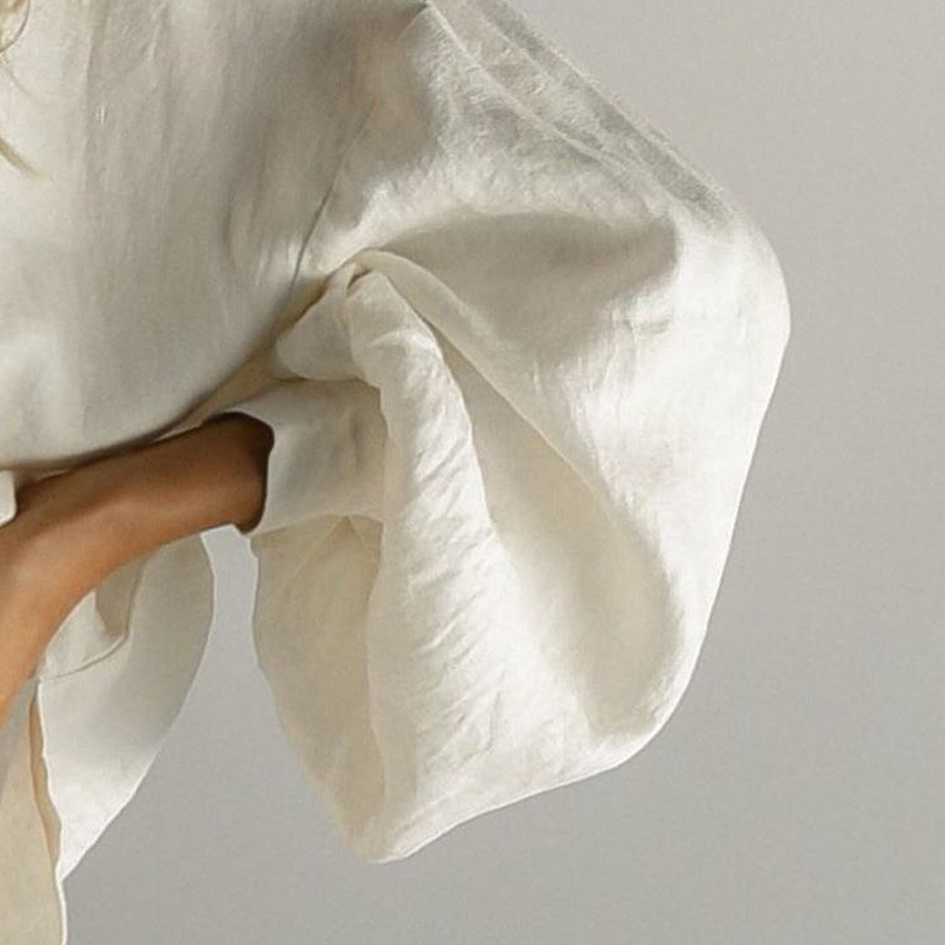
Perhaps no characteristic is more immediately associated with linen than its texture.
That texture is part of its identity.
Fine linen does not necessarily strive for the perfectly uniform surface associated with synthetic materials. Its natural character can reveal itself through subtle variations in yarn and weave, giving the cloth depth and movement.
Run your hand across a linen fabric and you begin to understand something that photographs cannot completely communicate.
Luxury is not always something you see. Sometimes, it is something you feel.
This sensory quality is particularly important in premium linen, where texture and hand become part of the experience of the finished garment. Robinto Marcini’s brand strategy similarly places texture and sensory experience at the centre of its European linen proposition.
Weight: The Way Linen Moves
Two linen fabrics can look similar and behave completely differently.
The reason may be their weight.
Lighter linen tends to move freely against the body, making it naturally suited to shirts, relaxed dresses and warm-weather garments.
Heavier constructions can offer greater structure, making them appropriate for jackets, trousers and more substantial tailoring.
Weight therefore influences more than comfort.
It determines how a garment falls, how it holds its silhouette and how it responds to movement.
For a designer or tailor, choosing linen is consequently not simply a question of colour.
It is a question of behaviour.
Finish: The Final Expression
After weaving, linen can undergo different finishing processes that influence its final appearance and hand.
Finishing can alter the fabric’s softness, surface character, lustre, drape and overall feel.
A more natural finish may preserve the unmistakable character of the fibre.
Other treatments may create a softer, smoother or more polished expression.
This is one of the reasons the word linen encompasses such a wide range of fabrics.
The raw material may share the same origin, yet the finished cloth can possess an entirely different personality.
When the Elements Come Together
Think of linen as a conversation between several elements:
Fibre gives it origin.
Yarn gives it character.
Weave gives it structure.
Texture gives it identity.
Weight gives it movement.
Finish gives it expression.
Change any one of these, and the fabric changes with it.
That is what makes understanding linen so fascinating.
The Fabric Behind the Garment
When a tailor chooses a linen, they are choosing much more than a colour.
They are choosing how a jacket will fall from the shoulder.
How a shirt will move with the body.
How sunlight will reveal its surface.
How the fabric will respond to a warm afternoon.
How it will age.
And ultimately, how the person wearing it will experience the garment.
The finished piece may be what we notice first.
But its character was decided much earlier—inside the fibre, within the yarn, across the weave and through the finishing process.
That is the anatomy of linen.
And once you learn to look closely, you never quite see the fabric the same way again.